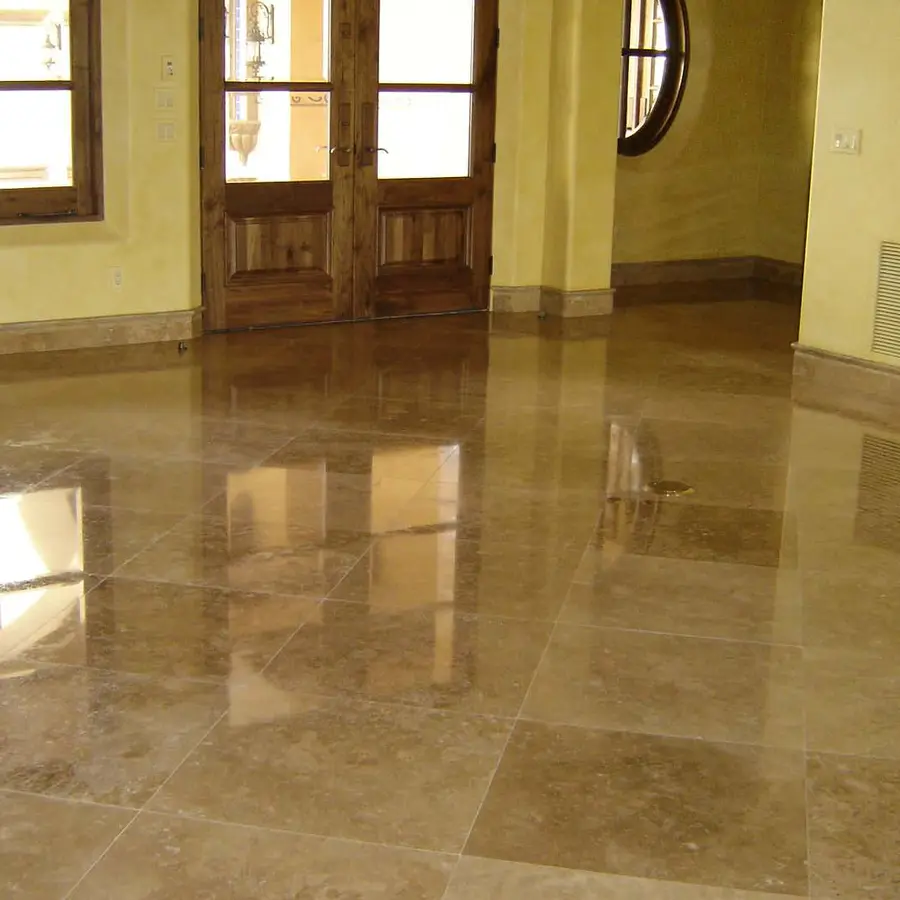
Travertine comes in cream, white, dark brown, reddish and similar shades. It forms from calcite deposited by hot springs, and water flowing through it leaves the holes that are usually filled with resin or cement. It is classed as a limestone or marble.
Most home installations have a honed surface: smooth, flat to low sheen, and very porous, so it should always be protected with a penetrating sealer. A polished surface is glossy and far less porous. Its shine comes from the stone’s own crystals, brought out with powders and diamond pads, not from a coating, and it wears away with traffic and the wrong cleaners.
Our process
First, protect and deep clean. We move furniture and mask cabinets, walls and carpet as needed. Then our power cleaning removes deeply embedded dirt: hand-scrubbed grout lines, machine scrubbing where needed, and an extraction rinse set to the right pressure for stone.
Then, hone and polish. We hone and polish to the shine you want, natural, satin or glossy. It takes time, and it is what makes a stone floor look great.
Next, fill and repair. Travertine develops small and large pits over time. We fill them with a travertine epoxy to stop further damage, and fill or replace cracked tiles.
Finally, seal. We apply a quality penetrating sealer to tile and grout. It gives the stain resistance that keeps dirt out of the stone. Sealers wear out over time, so resealing is part of the maintenance cycle.
New installations
New travertine and marble should be cleaned well and sealed after installation, and many owners add a polish to improve the gloss. Call us as soon as your stone is in.
Why it takes a specialist
The wrong tools and cleaners damage travertine and marble, and fixing that can cost more than doing it right the first time. After every job we leave you with simple care instructions so you spend more time enjoying the floor and less time calling us.
Between visits, follow our travertine care guide or marble care guide.